Understanding Mobile Proxy: Mobile Proxy vs. Residential Proxy
In fields like cross-border e-commerce, social media marketing, ad placement, and data collection, proxy IPs have become essential tools. The most common types are Residential Proxies and Mobile Proxies.
I. What is a Mobile Proxy?
A Mobile Proxy provides IP addresses assigned by real mobile network operators (ISPs) via 3G, 4G, or 5G networks. It connects through cellular data emitted by real mobile devices like smartphones.
- Residential Proxy: Similar to a fixed home address; stable and authentic.
- Mobile Proxy: Similar to a mobile phone address that changes as you move between base stations. It appears as a normal user surfing the web on mobile data.
- Data Center Proxy: Like a virtual office address; easily identified as "non-human" by websites.
The core advantage of Mobile Proxies lies in their extreme anonymity and authenticity.
II.
Four Key Characteristics
1. Based on Real ISP Networks
IPs come from mobile providers like AT&T, Verizon (US), Vodafone (Europe), or China Mobile (Asia), carrying a "real user" tag.
2. Dynamic Rotation
Supports automatic IP switching through redialing or switching base stations to avoid bans from overusing a single IP.
3. High Camouflage
Since thousands of users may share one base station IP, platforms find it nearly impossible to distinguish proxy traffic from real mobile users.
4. Anti-Blocking Capability
For sites with strict anti-crawling mechanisms, mobile IPs are the hardest to block because banning one might accidentally block thousands of real innocent users.
In short: Mobile proxies disguise your operations as real mobile user behavior.

III.
Golden Application Scenarios
- Social Media Management: Large-scale registration and account nurturing on TikTok, Instagram, and Reddit.
- Ad Placement & Testing: Fast environment switching on Facebook/Google Ads to reduce the risk of bans during high-frequency operations.
- E-commerce Scaling: Increasing account survival rates during big promotions on Amazon, eBay, or Shopee.
- Data Collection: Bypassing strict anti-scraping filters, especially when collecting mobile-end data.

IV.
Important Considerations
- Higher Cost: Mobile resources are scarce and generally more expensive than residential proxies.
- Bandwidth Limits: Speeds may be less stable than top-tier data center proxies as they rely on cellular networks.
- Rotation Frequency: Excessive IP switching can still trigger account anomalies; strategy is key.
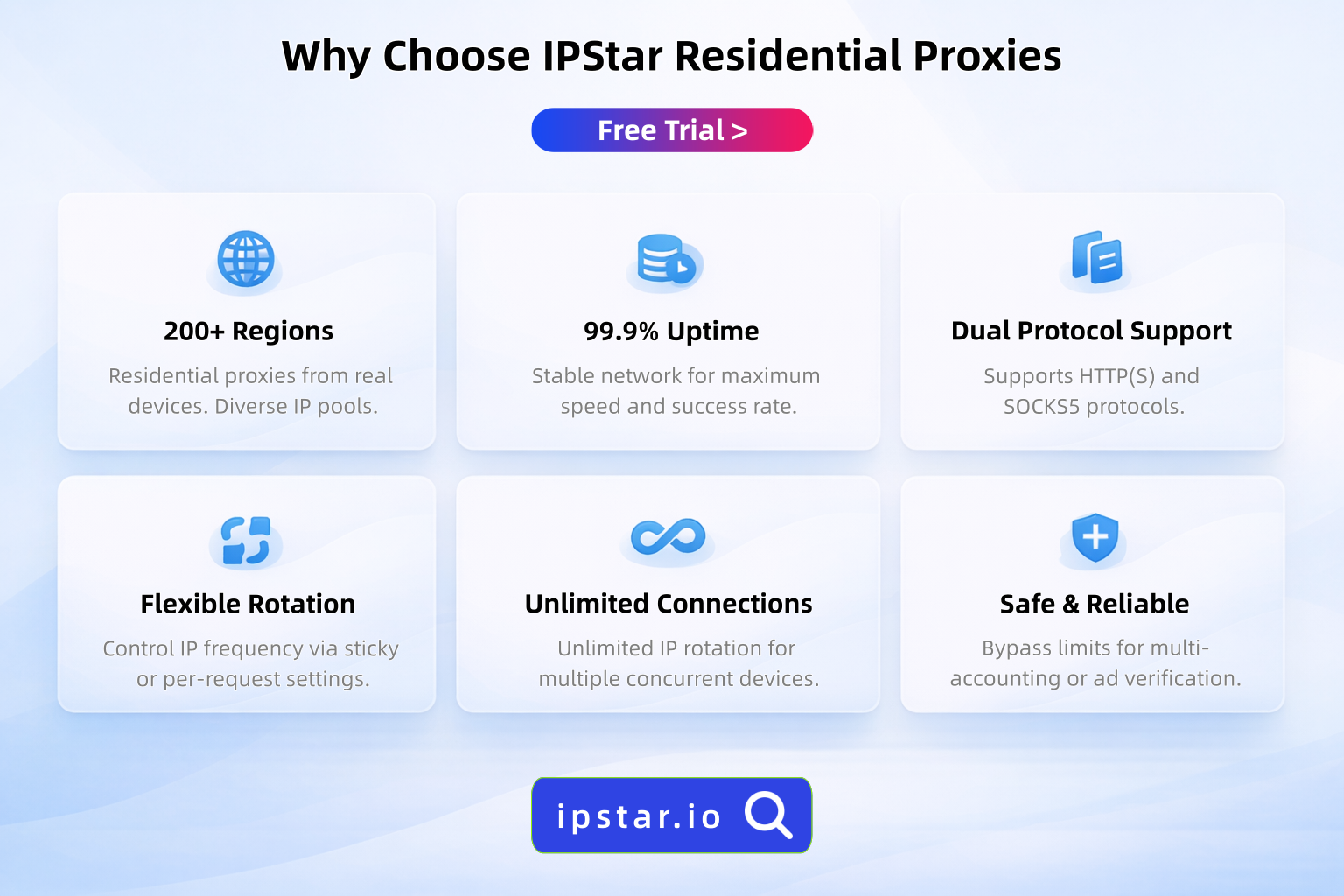
- Provider Choice: Choose providers with real ISP nodes, such as IPStar, which offers over 90 million IPs across 200+ countries.
V. Summary
- Residential Proxies: High stability; best for long-term account maintenance and detailed operations.
- Mobile Proxies: Strongest anti-ban capability; best for bulk operations, aggressive scaling, and high-risk tasks.
Even with high-quality IPs, you must maintain good scraping ethics and reasonable request frequencies to minimize risk.